Second Front Systems · Documentation Platform Owner / Lead Technical Writer
From fragmented documentation to an AI-native documentation platform
Overview
When I joined Second Front, documentation was spread across outdated websites, duplicated content, and disconnected repositories maintained by different teams. Customers struggled to find reliable onboarding guidance, implementation teams lacked a consistent source of truth, and Product needed better visibility into the gaps between platform capabilities and customer expectations.
I took ownership of bringing these pieces together. What started as a documentation overhaul evolved into designing and independently building an entirely new documentation platform from scratch.
The platform brought together the flexibility of a self-hosted solution with capabilities typically found in commercial documentation products. It supported private documentation, API references, versioning, offline deliverables, and AI-native documentation workflows, while meeting the deployment requirements of restricted government environments.
This wasn't just a documentation migration. It was an opportunity to rethink how documentation was created, delivered, maintained, and consumed by both people and AI systems.
Project at a glance
| Area | Details |
|---|---|
| Role | Documentation Platform Owner / Lead Technical Writer |
| Platform | Designed and built from scratch |
| Technology | Next.js, React, TypeScript |
| Legacy content | 2 repositories, approximately 150 Markdown files |
| Contributors | Approximately 5 occasional contributors |
| Audience | 100+ customers |
| Deployment contexts | DoW IL2/IL4/IL5/IL6, DIU, FedRAMP Class B/C/D, GovRAMP, and other restricted environments |
| Authentication | NextAuth.js, Keycloak OIDC |
| Deployment | Docker, Helm, Harbor Registry |
| Scope | Strategy, content, product requirements, architecture, development, deployment, and ongoing operations |
01. The challenge: Documentation without ownership
I inherited two documentation repositories: one for the Game Warden platform and another for the Game Warden web application. Together, they contained approximately 150 Markdown files.
Around five people had contributed information over time, but there was no consistent process for reviewing, validating, or maintaining it. Content had accumulated without clear ownership, resulting in duplicated, outdated, and sometimes confusing documentation.
The problems extended beyond the content itself.
Fragmented customer information
- Multiple customer-facing documentation sites contained outdated and duplicated information.
- Content had been assembled by different contributors without consistent editorial standards or information architecture.
- Customers had difficulty finding reliable information to onboard and operate the platform.
Outdated documentation infrastructure
- The existing MkDocs setup was built on an outdated technology stack.
- The infrastructure had no clear owner or roadmap.
- Extending the existing setup would mean continuing to work around limitations rather than building the capabilities we needed.
Cross-functional misalignment
- Implementation teams struggled to guide customers through onboarding and mission-critical accreditation requirements.
- Product teams needed better visibility into platform limitations and the gap between product capabilities and customer expectations.
- Teams needed a more consistent understanding of what the platform could actually deliver.
Complex deployment requirements
Documentation needed to support hundreds of customers across commercial and government environments.
The challenge was to establish a reliable source of truth while building infrastructure capable of supporting the security, operational, and customer experience requirements of the business.
02. The strategy: Treat documentation as a product
I approached this as an evolving product initiative rather than a one-time documentation cleanup.
The immediate priority was to consolidate information, validate its accuracy, and make it easier for customers to find what they needed. But I also recognized that the existing documentation infrastructure would continue to limit us as the product grew.
Rather than investing further in an outdated technology stack or depending on another third-party vendor's roadmap, I proposed building an internally owned documentation platform from scratch.
The vision was to combine the flexibility and control of a self-hosted platform with the capabilities expected from modern documentation products.
It needed to:
- Provide a consistent, customer-facing source of truth.
- Support public and private documentation.
- Integrate API references and product documentation.
- Support versioning, search, navigation, and content management.
- Produce offline documentation deliverables for air-gapped environments.
- Operate within restricted government deployment environments.
- Support AI-assisted discovery and machine-readable documentation.
- Give us control over the platform's roadmap and future capabilities.
03. Content transformation: Establishing a reliable source of truth
Before building the new platform, I focused on improving the quality and structure of the information it would serve.
What I did:
- Audited and rewrote the existing documentation across both repositories.
- Validated technical content with the teams responsible for the product and its implementation.
- Identified missing information and developed documentation to address customer and implementation needs.
- Redesigned the information architecture to make content easier to navigate and maintain.
- Established a more consistent foundation for documentation across the Game Warden platform and web application.
- Supported documentation development for the next generation of the product, Game Warden 2.0.
This work helped to turn accumulated information into a dependable knowledge source that customers, implementation teams, and eventually AI systems could rely on.
04. Platform development: Building an internally owned product
I designed and built the new documentation platform using Next.js, React, and TypeScript, taking ownership of product requirements, architecture, implementation, and ongoing feature development.
Core platform capabilities
| Category | Capabilities and implementation |
|---|---|
| Content management and publishing | - Markdown-based documentation authoring and publishing. - Content management and structured navigation. - Documentation versioning. - Search and content discovery. |
| Developer documentation | - Integrated API documentation capabilities. - Support for multiple documentation experiences and product areas. |
| Authentication and access control | - Implemented authentication using NextAuth.js and Keycloak OIDC. - Allowed customers to authenticate using their existing Game Warden credentials. - Supported private documentation for controlled access to sensitive customer information. |
| Offline documentation | - Built offline documentation deliverables that could be packaged and distributed into air-gapped environments. - Enabled customers to access documentation in environments without internet connectivity. |
| Deployment and infrastructure | - Designed the platform for self-hosted deployment in restricted environments. - Used Docker to containerize the application. - Used Helm for deployment. - Integrated Harbor Registry into the container image build and scanning workflow. - Managed deployments and ongoing vulnerability remediation, including CVE management. |
From proof of concept to an evolving product
I started by building a proof of concept to demonstrate the platform's potential and presented it to leadership.
Following approval, I continued developing the platform, prioritizing and implementing additional capabilities as product requirements and customer needs evolved.
Instead of depending on a third-party vendor's roadmap, we could build around our own operational requirements, security constraints, and customer needs.
05. AI-native documentation: Building for people and machines
I recognized that documentation needed to serve more than human readers. It also needed to become a reliable knowledge source for AI assistants and agents.
This started with the content itself. Rewriting and restructuring the legacy documentation established a cleaner, more consistent foundation for the in-house AI assistant.
I then introduced capabilities into the new platform to make documentation easier for AI systems to discover, consume, and retrieve.
| Feature | Description |
|---|---|
Machine-readable documentation with llms.txt | Implemented llms.txt to provide an AI-readable documentation index, helping external AI systems discover available documentation. |
| AI-specific content controls | Introduced <LLMOnly> and <LLMIgnore> directives to control how content is exposed to AI systems, allowing documentation authors to distinguish content intended for AI consumption from content that should be excluded. |
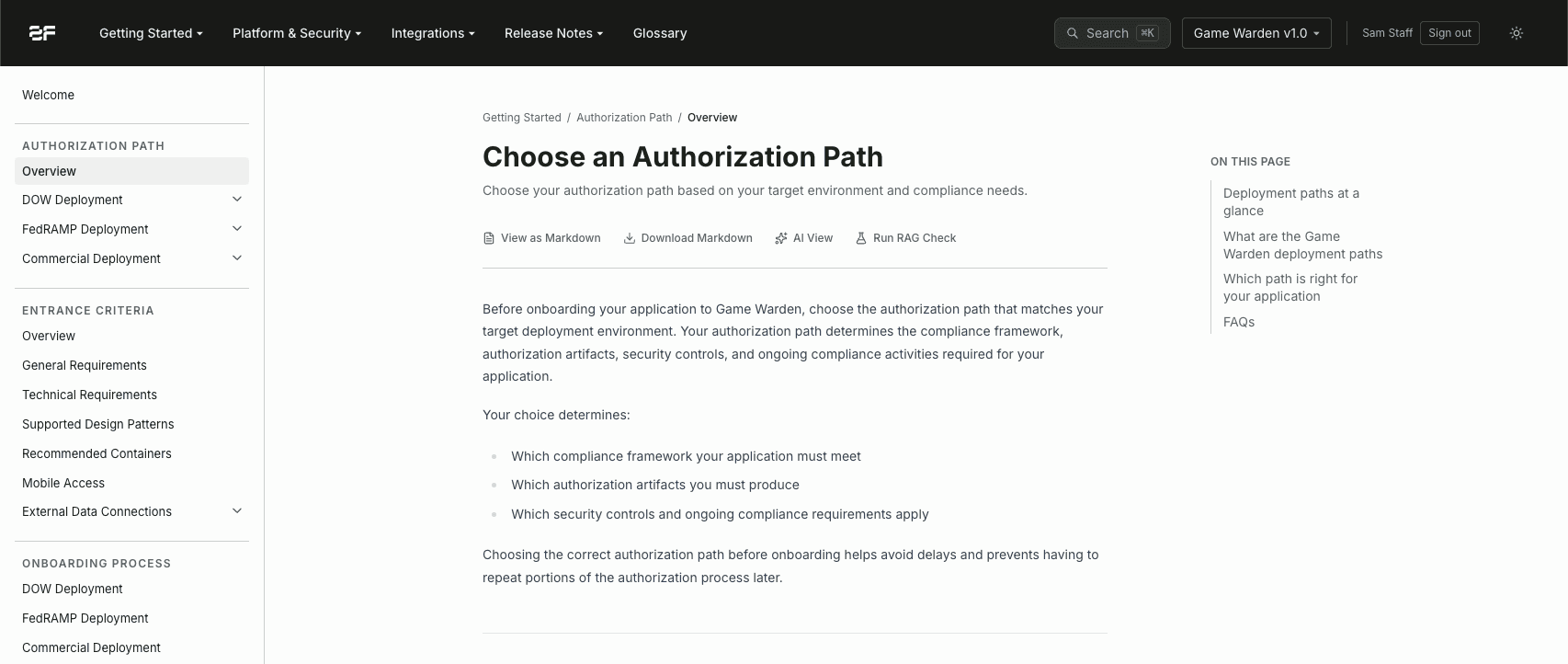
| AI View | Developed AI View to inspect documentation from an AI consumption perspective. This provided a way to review how content was presented to AI systems and continuously refine it to provide better context. |
| RAG Readiness Check | Built a way to evaluate documentation for retrieval readiness, including: - Retrievability - Chunk independence - Grounding readiness - Format robustness - Query coverage - Cross-link quality The tool also evaluated test queries against documentation chunks and surfaced findings such as unrelated chunks, generic headings, and missing internal links. |
The result was a documentation platform designed to support both traditional customer self-service and AI-powered knowledge retrieval.
06. The outcome: Beyond a documentation migration
What started as a documentation cleanup evolved into an internally owned documentation platform supporting hundreds of customers across complex government and commercial deployment environments.
Greater control over sensitive information
The new authentication and private documentation capabilities allowed us to provide more sensitive documentation directly to authorized customers.
Documentation for air-gapped environments
Offline documentation deliverables enabled customers to receive and access documentation in air-gapped environments without relying on internet connectivity.
Reduced platform costs
Replacing third-party documentation tooling reduced ongoing software costs while giving us full ownership of the platform and its roadmap.
A foundation for AI-assisted knowledge access
Rewritten and structured documentation established a foundation for the in-house AI assistant. AI-native platform capabilities also made documentation more discoverable and consumable by external AI agents.
A more sustainable documentation operation
Consolidated content, improved information architecture, and an internally maintained platform gave us a foundation for evolving documentation alongside the product rather than continually working around the limitations of legacy tooling.
What this project demonstrates
This project reflects how I approach documentation as a product and take ownership beyond the boundaries of traditional technical writing.
- Product thinking: Identifying infrastructure gaps, translating operational needs into product requirements, and prioritizing capabilities.
- Independent product development: Designing and building a complete documentation platform from scratch.
- Technical depth: Working across application architecture, authentication, deployment, containerization, and vulnerability management.
- Customer experience: Making complex product and compliance information easier to discover, understand, and access.
- AI readiness: Building documentation workflows and platform capabilities for both human and machine consumption.
- Long-term ownership: Continuing to develop, maintain, and improve the platform as product and customer needs evolve.